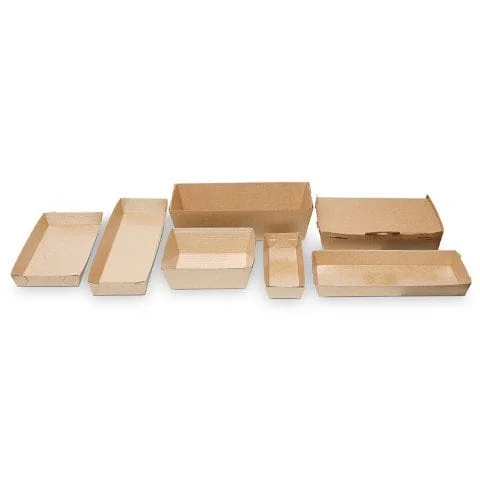
Short answer. No single tray material wins on every criterion. Aluminium conducts heat fastest and tolerates the highest temperatures, but it blocks standard metal detectors, reacts with acidic or salty foods when uncoated, and carries a high carbon footprint unless it is made from recycled metal. CPET is the most proven format for wet, sealed ready meals, yet it softens near 70 °C and its recycling depends on sorting infrastructure. PET-coated pressed paperboard and corrugated board trays move the pack into the paper recycling stream and insulate the product, with a rated window of about −40 or −28 to +220 °C. The right choice depends on the product, the line and the market the pack is sold in.
This analysis compares the four material families used for ovenable food trays in industrial bakery and prepared food: aluminium foil, crystallised PET (CPET), PET-coated pressed paperboard and corrugated board board such as G-Flute and F-Flute. It draws on manufacturer technical data, peer-reviewed life cycle studies, food safety authorities and the text of the EU Packaging and Packaging Waste Regulation.
Research questions
- Which temperature window and heat transfer behaviour does each material offer, and what does that mean for baking and reheating?
- What food safety and compliance issues does each material raise, including migration, PFAS and foreign body inspection?
- What do life cycle assessments say about the climate and resource impact of each material?
- How recyclable is each tray in practice, and how will the PPWR recyclability grades change that?
- Which operational factors (weight, line handling, printability, consumer perception) separate the options?
The four material families
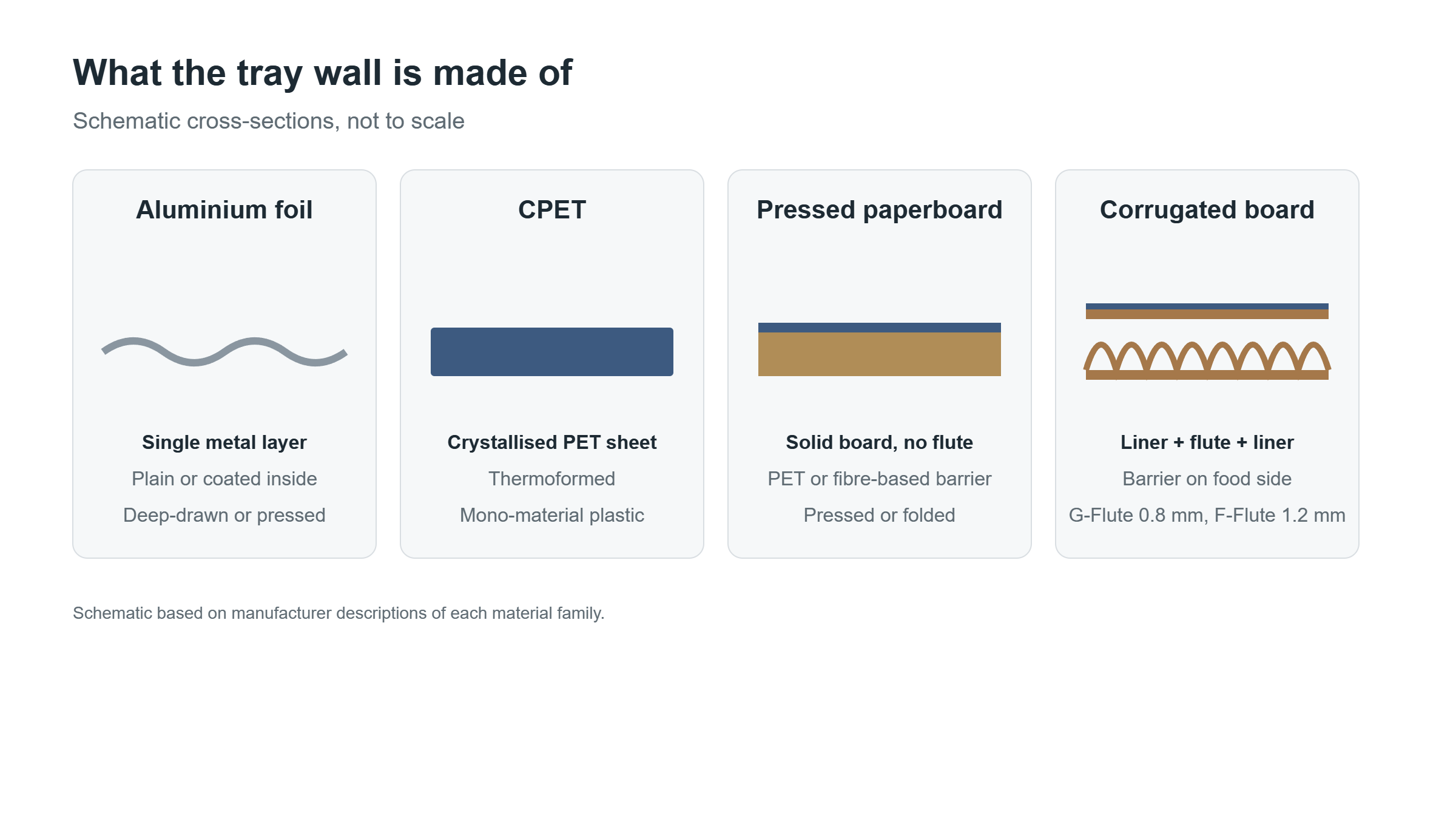
- Aluminium foil trays are deep-drawn or pressed from a single metal foil. They may be plain or coated on the food side.
- CPET trays are thermoformed from crystallised polyethylene terephthalate, a mono-material plastic that holds its shape at oven temperatures.
- Pressed paperboard trays are pressed or folded from solid board with a food-side barrier, usually extruded PET, or a fibre-based barrier in newer grades[6][8].
- Corrugated board trays combine two liners and a fluted medium. Fine flutes such as G-Flute (0.8 mm overall) and F-Flute (1.2 mm) give a rigid, light wall with a barrier layer on the food side.
1. Temperature window and heat transfer
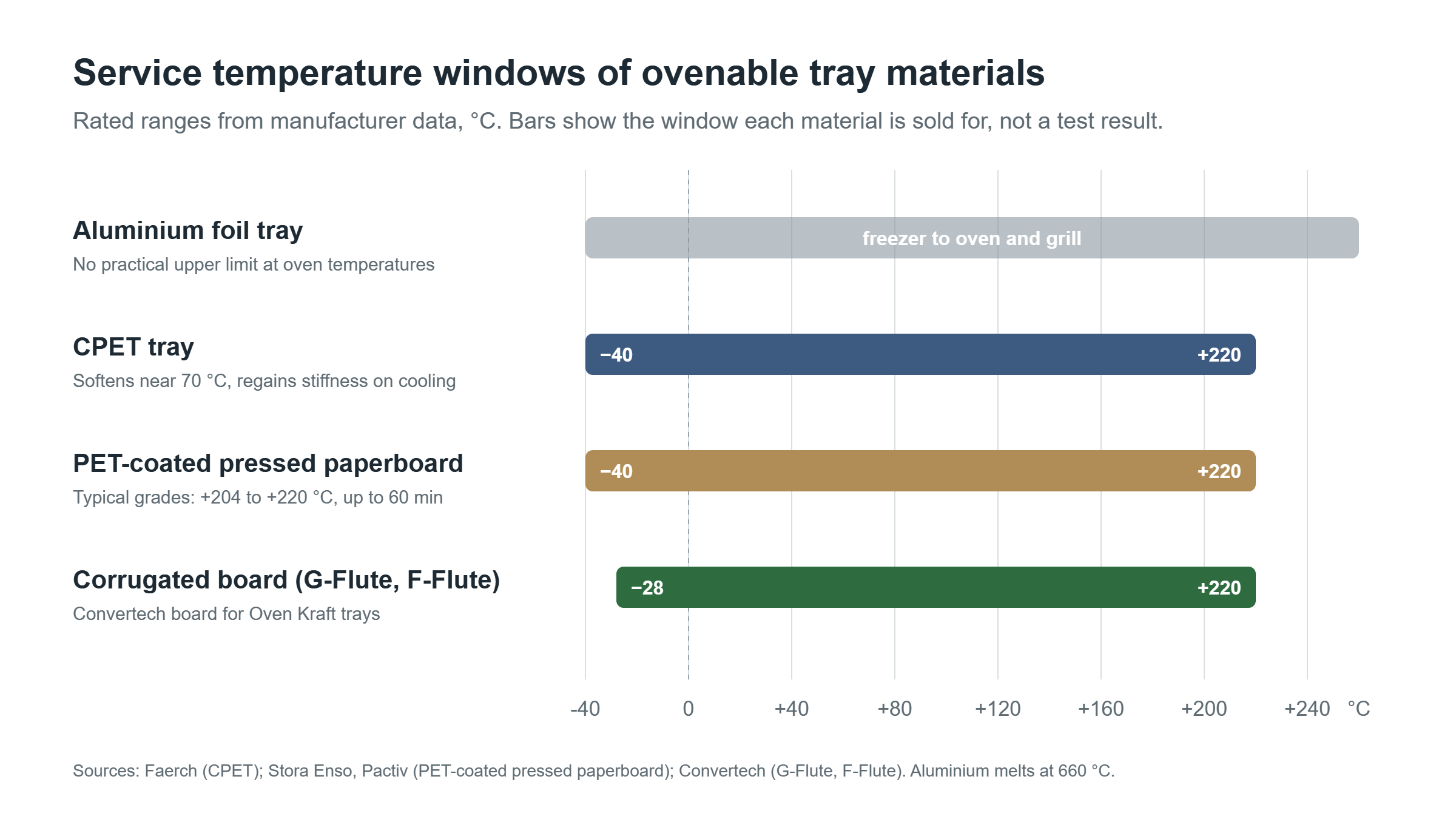
Rated temperature windows overlap more than marketing suggests. CPET is sold for −40 to +220 °C[4], PET-coated paperboard grades for conventional ovens up to 220 °C[6] or 204 °C for 60 minutes[7], and Convertech’s G-Flute and F-Flute trays for −28 to +220 °C. Aluminium has no practical upper limit at oven temperatures, which is why it remains the default for grilling and very high heat browning.
The more important difference is how fast heat moves through the wall. Aluminium conducts heat at about 237 W/m·K[23]. Amorphous polymers sit between 0.1 and 0.5 W/m·K[25], and corrugated paperboard, with air trapped in the fluting, measures roughly 0.05 to 0.07 W/m·K[24]. That is a difference of three to four orders of magnitude.
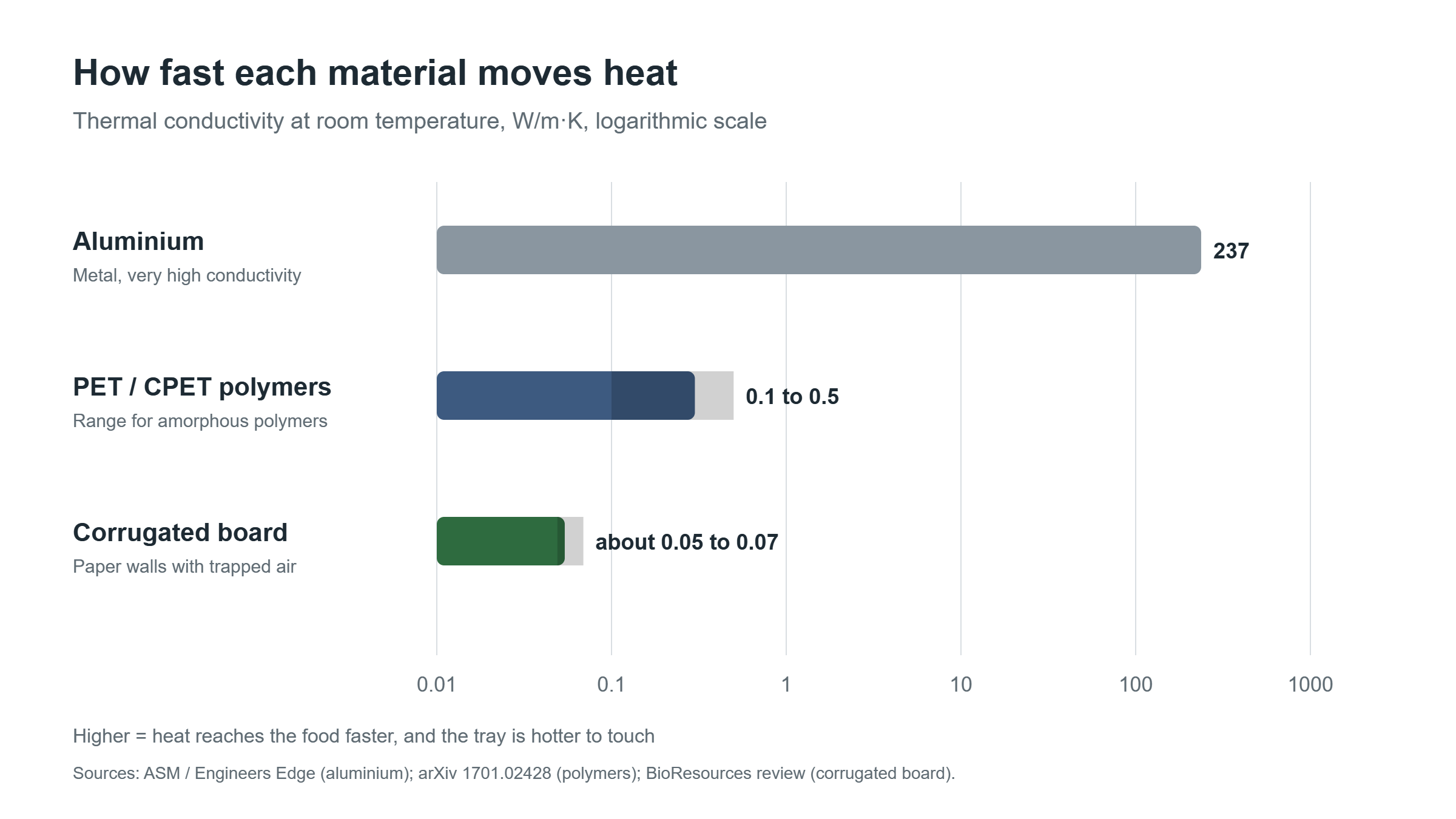
Two practical consequences follow. First, an aluminium tray transfers oven heat directly into the base of the product, which favours a firm bottom crust, while a fibre tray insulates the base and shifts more of the heat load to the air around the product. Bake profiles usually need adjustment when switching material, which is why line trials matter more than data sheets. Second, a fibre tray stays far cooler to the touch when it leaves the oven, a handling and safety benefit in retail bake-off and at the point of consumption.
CPET behaves differently again. It remains functional up to 220 °C, but its glass transition sits near 70 °C, so a hot CPET tray is soft until it cools and is not recommended for prolonged warm holding[5].
Microwave compatibility
CPET and PET-coated paperboard are dual-ovenable by design[4][7]. Aluminium trays can be heated in microwave ovens when the usage instructions are followed[11], but food in a metal tray heats mainly from the top, so shallow fills are recommended[12]. For products sold with a microwave instruction, this is a real formulation constraint.
2. Food safety and compliance
Aluminium migration
The German Federal Institute for Risk Assessment (BfR) measured high transfer of aluminium ions from uncoated aluminium meal trays into acidic foods, particularly when the food was kept warm after cook-chill, and advises against preparing or storing acidic or salty foods in uncoated aluminium[9]. The aluminium foil industry’s response is to use internally coated containers for such foods[10]. For bakers this is a limited issue with dry doughs, but relevant for fruit fillings, tomato-based toppings and brined products.
PFAS
Since the PPWR began to apply, food-contact packaging placed on the EU market must not contain PFAS at or above 25 ppb for any single PFAS, 250 ppb for the sum of targeted PFAS, or 50 ppm total fluorine[1][2]. The limit applies to every material, but it matters most for fibre-based trays, where fluorinated grease barriers were historically used. A fibre tray that relies on a polymer or fibre-based barrier instead of fluorochemistry meets the rule by design, but buyers should still request PFAS test evidence for each grade.
Foreign body inspection
Standard balanced-coil metal detectors cannot inspect products packed in aluminium foil trays, because the tray itself reads as metal. X-ray systems are required instead[13]. CPET, paperboard and corrugated board trays all allow conventional metal detection after packing. For a bakery that already runs metal detectors at the end of the line, this alone can decide the business case.
3. Environmental footprint: what life cycle studies show
Two findings recur across the literature. The first is that the material is not a reliable predictor on its own. A review of food service ware LCAs for the Oregon Department of Environmental Quality concluded that there is no clear best single-use material for climate impact, although paperboard often scored marginally lower[17]. The UNEP meta-analysis of take-away packaging reached a similar conclusion: paper-based single-use packaging is often preferable, but end-of-life infrastructure and geography can reverse the ranking[16].
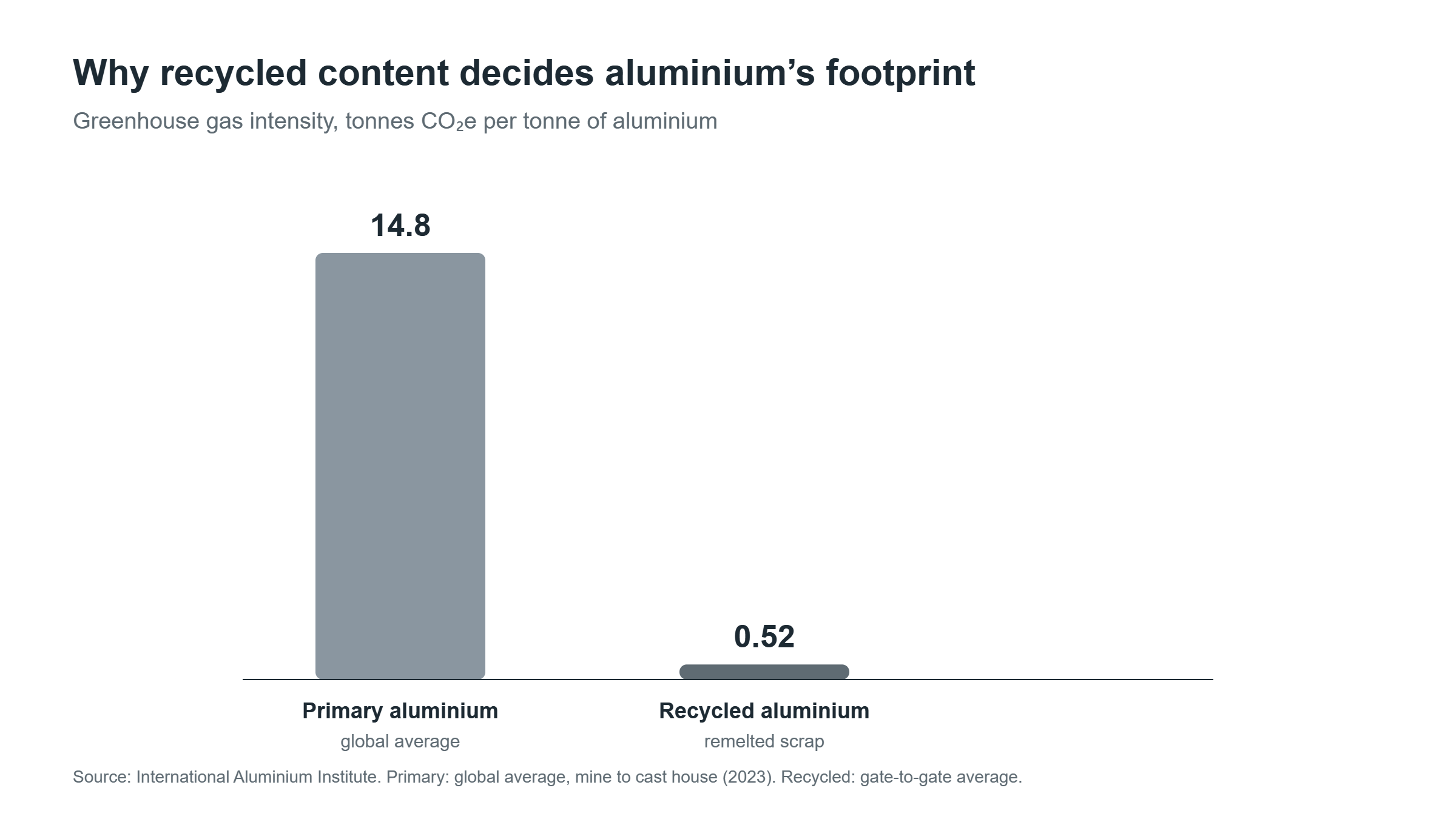
The second is that aluminium’s footprint depends almost entirely on recycled content. The International Aluminium Institute reports a global average of 14.8 tonnes CO₂e per tonne of primary aluminium[14], against about 0.52 tonnes for recycled aluminium[15]. In the UNEP review, a single-use aluminium container ranked worst in several categories, including depletion of elements and human toxicity, while the authors note that higher recycling rates could change the conclusion[16]. A recent comparative LCA of take-away containers found aluminium foil boxes more than 3.7 times higher than the other materials across nine impact indicators[18].
One caveat applies to every comparison: the food inside the tray usually carries a far larger footprint than the tray itself[16]. A tray that reduces breakage, spoilage or rejects on the line can outweigh small differences in material impact.
4. Recycling in practice and the PPWR grades
Paper and cardboard already form the largest packaging waste stream in the EU, at 40.4% of the total[19], and the infrastructure for collecting it is mature. Plastic packaging reached a recycling rate of 42.1%[20]. These system figures matter because the PPWR will grade packaging on real recyclability, not on theoretical potential.
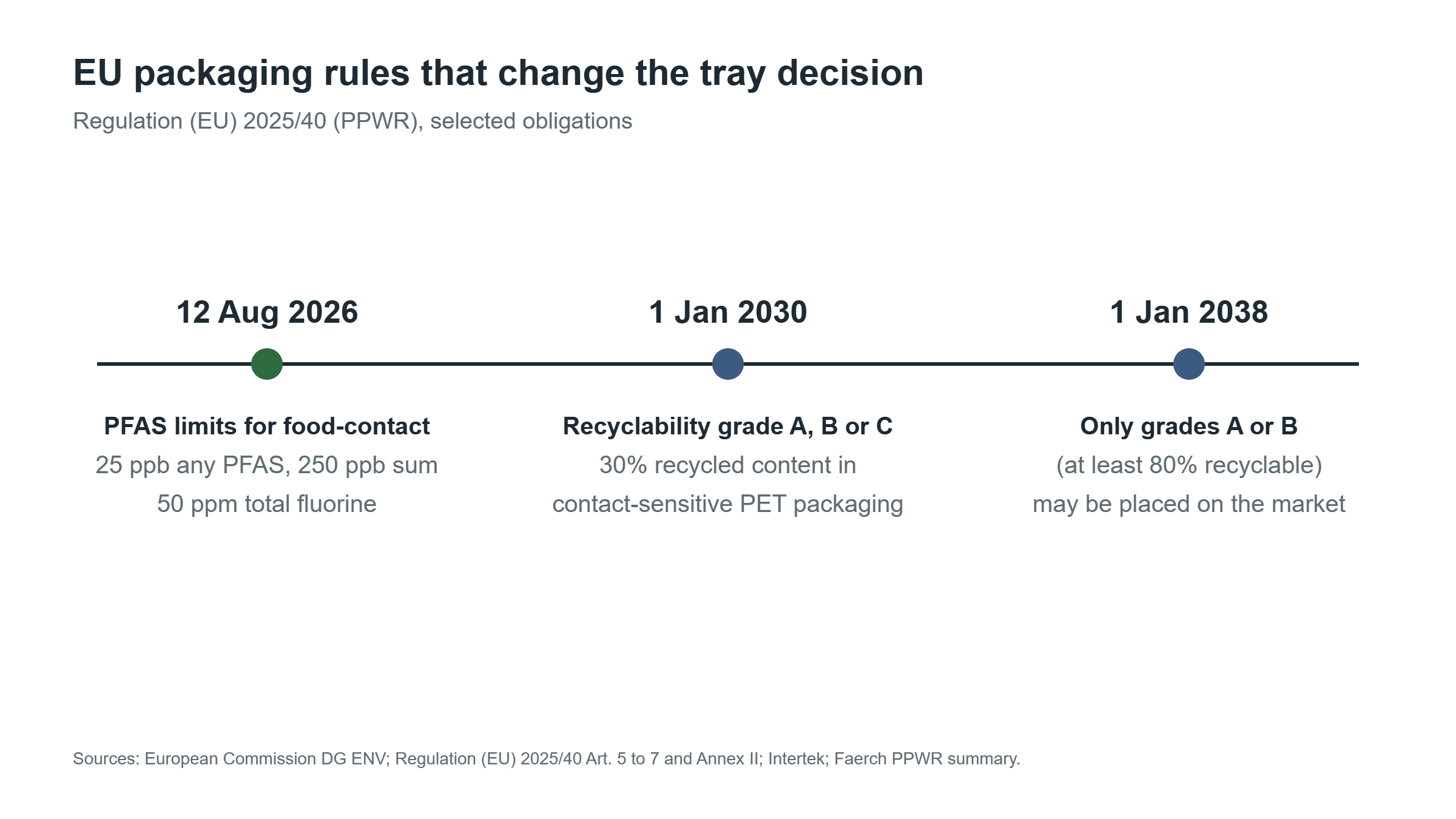
From 2030, packaging must reach recyclability grade A, B or C, meaning at least 70% recyclable by weight; from 2038 only grades A or B remain[3][26]. Each material faces a different question under this test:
- Aluminium is recyclable in metal streams, and the EU target for aluminium packaging is 60% by 2030[19]. Food residue on used trays reduces the share actually recovered.
- CPET is recyclable tray-to-tray where the infrastructure exists, but carbon-black trays have historically been invisible to the near-infrared sorters used in recycling plants[21]. Plastic parts will also carry minimum recycled content obligations from 2030[26].
- Pressed paperboard and corrugated board are assessed as paper when the plastic share is low. Some suppliers state that trays with less than 5% plastic content are recyclable in standard paper streams[8]. The exact threshold for each format will follow from the delegated acts on design for recycling.
5. Operational and commercial factors
- Weight. In one European LCA, a 670 ml aluminium take-away container weighed 14.5 g[16]. A 740 ml dual-ovenable CPET tray on the UK market weighs about 26 g. Fibre tray weights vary with format and flute, and should be compared on the same product and fill.
- Rigidity on the line. Thin aluminium dents in handling. CPET becomes brittle at very low temperatures and soft when hot[5]. Corrugated board gains stiffness from the fluted structure, which matters for depositing, freezing and stacking.
- Print and brand surface. Fibre trays can be printed directly, which turns the baking form into the retail display.
- Consumer perception. In a 2025 survey of more than 12,000 consumers, 53% of Europeans said paper packaging is better for the environment, and 62% preferred paper-based packaging for online orders[22]. Perception does not replace LCA evidence, but it influences retailer specifications.
Comparison table
| Criterion | Aluminium foil | CPET | Pressed paperboard (PET-coated) | Corrugated board (G-Flute, F-Flute) |
|---|---|---|---|---|
| Rated temperature window | Freezer to oven and grill | −40 to +220 °C | Up to 204 to 220 °C, by grade | −28 to +220 °C |
| Heat transfer through wall | Very fast (about 237 W/m·K) | Slow (0.1 to 0.5 W/m·K) | Slow, insulating | Slowest, insulating (about 0.05 W/m·K) |
| Touch temperature after baking | Hot | Hot and soft until cooled | Cool to warm | Cool to warm |
| Microwave | Possible with instructions, top heating | Yes, dual-ovenable | Yes, dual-ovenable | Depends on product approval |
| Metal detection after packing | No, X-ray needed | Yes | Yes | Yes |
| Acidic or salty foods | Coated trays recommended | Suitable | Suitable | Suitable with barrier |
| Recycling stream | Metal | Plastic (PET); black grades hard to sort | Paper, if plastic share is low | Paper, if plastic share is low |
| Climate footprint driver | Share of recycled aluminium | Virgin vs recycled PET | Board and barrier | Board and barrier |
| Direct print on tray | Limited | Limited | Yes | Yes |
Which tray fits which product
- Aluminium remains the strongest choice for very high heat, grilling and products that need maximum bottom heat, where X-ray inspection is already in place and metal recycling is reliable.
- CPET fits wet, sealed ready meals that need a hermetic lidding seal and microwave reheating, in markets with tray-to-tray PET recycling.
- Pressed paperboard suits shallow ready meals and sealed formats where a paper-based pack and dual ovenability are required.
- Corrugated board suits bake-in, freeze and ship programmes in industrial and in-store bakery, where rigidity, metal detection, insulation and a printable retail surface matter. G-Flute serves shallow and medium formats; F-Flute gives the stiffer wall needed for deep pans and heavy batters.
Limitations of this analysis
LCA results differ by functional unit, region, electricity mix and end-of-life assumptions, and few published studies compare all four materials on the same baked product. Temperature windows are manufacturer ratings, not independent tests. Recyclability under the PPWR will be defined in delegated acts that are still being drafted. Any switch of tray material should therefore be validated by a line trial on the actual product, with documentation of migration and PFAS compliance from the supplier.
This analysis was prepared by Convertech Paper Industries, which develops and produces G-Flute and F-Flute ovenable board for its Oven Kraft trays. The comparison relies on independent and manufacturer sources, listed below.
References
- European Commission, DG Environment. New EU packaging rules start to apply, including restrictions on PFAS in food-contact packaging.
- Intertek. EU PPWR requirements effective from August 2026.
- Faerch. PPWR: impacts on packaging.
- Faerch. CPET material and technology.
- Duni Group. Environmental and product information sheet: CPET tray.
- Stora Enso. Trayforma paperboard materials for trays.
- Pactiv. Pressware dual-ovenable paperboard containers, specification.
- Walki. Walki Pack Tray.
- German Federal Institute for Risk Assessment (BfR). Proof of the transfer of aluminium from menu trays to food.
- European Aluminium Foil Association. Aluminium release from aluminium trays.
- European Aluminium Foil Association. Microwaveability of aluminium foil packages, executive summary.
- USDA Food Safety and Inspection Service. Cooking safely in the microwave oven.
- Mettler-Toledo, via Food Processing. Metal detection, X-ray or both?
- International Aluminium Institute. Global aluminium industry greenhouse gas emissions intensity reduction continues.
- International Aluminium Institute. Aluminium recycling reduces greenhouse gas emissions by over 90%.
- United Nations Environment Programme. Single-use plastic take-away food packaging and its alternatives: recommendations from life cycle assessments.
- Oregon Department of Environmental Quality. Food service ware life cycle assessment review.
- Cui, X. et al. Multi-indicators environmental impact analysis of takeaway lunch boxes based on life cycle assessment. Environmental Research 265, 120458.
- Eurostat. Packaging waste statistics.
- Packaging Europe. The EU’s packaging and recycling trends.
- Waste Management World. Project to enable NIR sorting of black CPET.
- Two Sides, Trend Tracker 2025, summary via Burgo. The perception of paper: sustainability and consumer preferences.
- Engineers Edge, after ASM Metals Reference Book. Thermal conductivity of common metals.
- BioResources. Experimental panels from recycled corrugated cardboard, review of thermal conductivity values.
- Thermal conductivity of bulk crystalline and single-chain polyethylene, arXiv 1701.02428.
- Regulation (EU) 2025/40 on packaging and packaging waste, Articles 5 to 7 and Annex II.